Friday
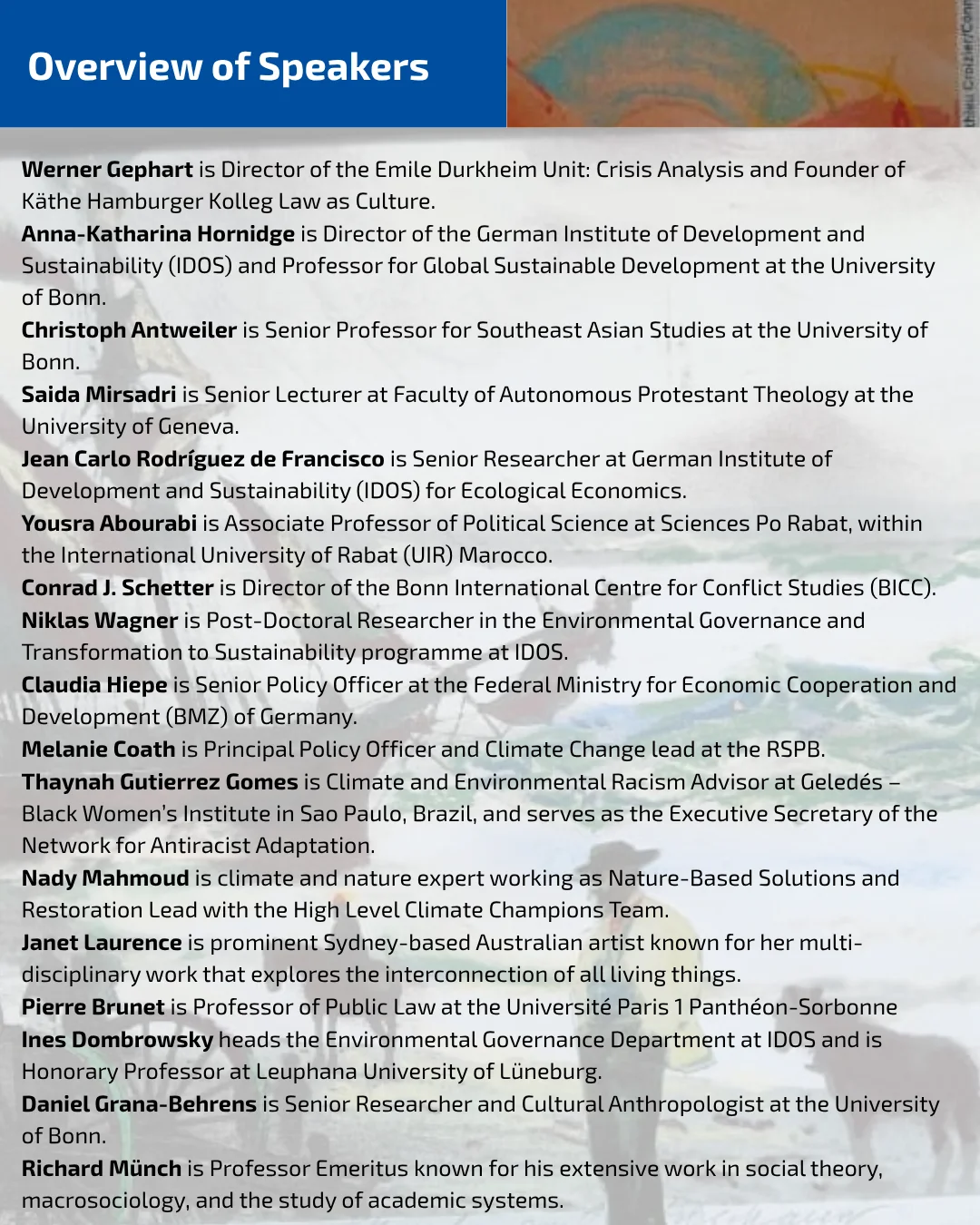
In his opening remarks, Werner Gephart recalled the hard physical facts of scientifically measurable changes: rising greenhouse gas concentrations, increasing radiative forcing, and the warming of oceans and global surface temperatures, phenomena accompanied by the shrinking cryosphere, ocean acidification, sea-level rise, and an increase in extreme weather events.
He then turned his attention to the societal divide, where climate change deniers and their allies - right-wing populists and nationalists, economic interest groups, libertarians, evangelical fundamentalists, and those hostile to science - use disinformation to downplay both the urgency of the crisis and the human impact on climate change. He posed the conference’s guiding question: from where might critical impulses emerge that champion the preservation of nature and a systemic response to the consequences of climate change, without slipping into a conservative agenda of restoring pre-modern social conditions?
In her opening remarks, Anna-Katharina Hornidge first adopted a meta-perspective, addressing the epistemological challenges and epistemic hierarchies within the scientific and political systems. Approaching the climate crisis as a polycrisis, she discussed region-specific characteristics and illustrated them using the consequences of extreme weather events.
Christoph Antweiler provided the initial fundamental food for thought with his keynote, "Anthropocene – A Conceptual Earthquake for Established Concepts of Nature?" He portrayed the Anthropocene epoch as a conceptual break with established understandings of nature, a kind of "earthquake" that destabilizes traditional distinctions between humanity and nature due to the irreversibility of human interventions in the natural world. After outlining the impact of human activity on nature, and questioning what "nature" actually signifies from a global perspective, he advocated for adopting a planetary perspective (as opposed to a more locally oriented ecology). In this view, as "Earthlings"—endowed with agency yet subject to ecological dependency and a loss of control—we should become fundamentally aware of nature’s volatility and the irreversibility of life, rather than striving for carefully balanced ecological equilibria, resilience, or sustainability. In doing so, he expanded the conference’s core question to include the mode of coexistence: How can humanity’s interconnected cultures coexist on a planet severely damaged by human action without everyone having to become the same?
Werner Gephart took up this question in his lecture, "The Re-Sacralisation of Nature: Will it Save the World?" Drawing on sociological perspectives regarding religion and the relationship with nature - as well as comparative insights from world religions (Protestantism, Daoism, Confucianism, Shintoism, Buddhism, the Islamic world) and the worldviews of indigenous peoples in South America - he argued that the ecological crisis and our view of nature cannot be understood solely through technical or political lenses; rather, they represent a crisis of meaning, moral orientation, and cultural imagination. Particularly striking was his point that it was not religion(s)—often the subject of criticism—per se, but rather the unbridled force of secularization and the accompanying reduction and rationalization of nature into an object of short-term utility and economic gain that helped legitimize its exploitation. In this light, might a reorientation toward the "sacredness" and symbolic elevation of nature, fostered by a global, interreligious dialogue among culture, strengthen the social and cultural foundations of environmental protection?
Saida Mirsadri’s presentation, "Rethinking Human-Nature Relations in Islamic Thought under Ecological Crisis," illustrated how religious traditions can offer ethical perspectives on humanity's responsibility toward the environment. In doing so, she highlighted positions within Islamic ecofeminism that extend beyond purely Quranic derivations.
Overall, the morning session made it clear that the relationship between humanity and nature is never simply a given; it is shaped by stories, symbols, worldviews, and intellectual traditions. This approach to the human-nature relationship in the Anthropocene provided an important backdrop for the transition to more practice-oriented discussions on how climate change can be addressed through governance structures. At the same time, it became evident that these debates are themselves shaped by, at times, sharply divergent assumptions regarding the nature of nature, humanity’s place within it, and the obligations arising from that relationship.
Jean Carlo Rodríguez-de-Francisco’s presentation, "Nature for whom? Nature-based Solutions and Environmental Justice," addressed this ambivalence between theory and policy, posing a question that was simple at first glance yet profound: Nature for whom? Although such solutions are often portrayed as win-win responses to biodiversity loss, climate adaptation, and water scarcity, he pointed out that they can also reproduce or exacerbate inequality if equity is treated as an afterthought rather than a constitutive principle of the solutions. Drawing on principles of distributive, procedural, and recognition justice, he illustrated that ecological success alone is insufficient. Instead, he emphasized that issues of participation, representation, and the recognition of local knowledge are crucial in determining whether environmental measures are perceived as legitimate and fair, and thus constitute an essential component of successful nature-based solutions.
In this way, the discussion shifted to the practical and political aspects of governance. The afternoon session focused less on symbolic meanings and more on the institutional and political dimensions.
Yousra Abourabi’s presentation, "Governance Challenges in Africa," examined the tensions that arise when global environmental norms are shaped by Western knowledge hierarchies and subsequently exported as supposedly universal models. She highlighted how the historical initiatives of African actors are often downplayed, while the failure to meet specific indicators, which primarily favor Western industrialized nation, draws criticism; furthermore, the call for "catch-up development" is dismissed as "ecologically unsound," a stance she noted was ironic coming from countries that industrialized in ways harmful to the climate. From this perspective, a meaningful transformation of African climate and industrial policy depends on strengthening African agency and taking regional initiatives and knowledge traditions seriously, rather than having sustainability imposed or mediated by industrialized Western state, a process that has largely resulted in little more than a "consultancy economy."
Conrad J. Schetter’s presentation, "Global Risk, Conflicts, and the Impossible Global Risk Society," emphasized that climate change interacts with broader systems of uncertainty rather than existing in isolation from them. Climate change exacerbates the vulnerability of social groups and can trigger self-reinforcing cycles of violence, as Schetter illustrated using the example of the Darfur conflict. In this sense, climate change acts as a "risk multiplier," with destructive consequences that extend far beyond the climate itself. However, if climate change is viewed not merely through the lens of risk but also as an opportunity, it becomes possible to envision "environmental peacebuilding, a concept exemplified by the case of Colombia.
Anna-Katharina Hornidge’s keynote, “Environmental Governance: Failures and Fallacies,” expanded on these themes to offer a broader reflection on the shifting relationship between knowledge, science, and environmental policy at a time when the authority of science itself is increasingly being undermined by political polarization, autocratization, disinformation, and weakened multilateral structures. She argued that current sustainability challenges can no longer be addressed through linear, growth-oriented, and sectorally isolated forms of science; instead, they require transdisciplinary and transformative modes of knowledge production. Her analysis of the evolving power-knowledge nexus demonstrated that science can no longer simply provide neutral facts for policymakers but must actively help shape governance, institutions, and visions of the future. Drawing on the concept of the “Anthropocene,” she also proposed the emergence of “Anthroposcience, or transformative science, as a form of inquiry that moves beyond purely external observation to explicitly integrate ecological and social responsibility into research practice. Knowledge generated for environmental policy, she contended, must not only explain the world but also help steer the changes occurring within it. This provided a powerful conceptual conclusion to the governance session: environmental policy fails not only due to weak or eroding institutions but also because the forms of knowledge underpinning it are often too narrowly defined, too fragmented, or too far removed from the social worlds they seek to influence.
The concluding discussion—moderated by Niklas Wagner and titled “The Climate-Nature Nexus in the Triple COP Year: Discourses Shaping Practice across the Rio Conventions”—linked the interplay between climate and nature during this “triple COP” year to the broader international political climate agenda and practice; the lively debate raised the question of whether we ought to foster—far more vigorously, through ecological pedagogy—the often-underestimated affective dimension of our relationship with nature and landscape: that is, “the love of nature.”
Saturday
Saturday morning began with a conversation with Australian artist Janet Laurence, centered on the premise: "The Breath in Art: Can Art Create the Space for Healing?" Her presentatio, featuring works such as "After Nature: Theatre of Trees" and "Deep Breathing Resuscitation for the Reef" through impressive slideshows and video clips, highlighted nature’s fragility in the context of climate change. It demonstrated how art can draw attention to the inherent (and fragile) wonder of nature without the work devolving into a mere "landscape" created through aestheticization. The impulse to heal human-inflicted destruction, embodied in the concept of "hospitals for coral, contrasted sharply with the profound grief of *memento mori* evoked by exhibits depicting nature that has been irrevocably destroyed. Thus, her art is neither mere illustration nor a decoration of ugliness; rather, it challenges us to engage emotionally with ecological loss and to advocate for the protection and restoration of nature. Janet Laurence’s work underscores the significance of the sensory and reflective power of artistic practice within environmental discourse and serves as a catalyst for political action; it also offers a potential link to the question raised by Werner Gephart regarding the re-sacralization of nature, perhaps through a "Temple of Nature", as a way to counter destruction.
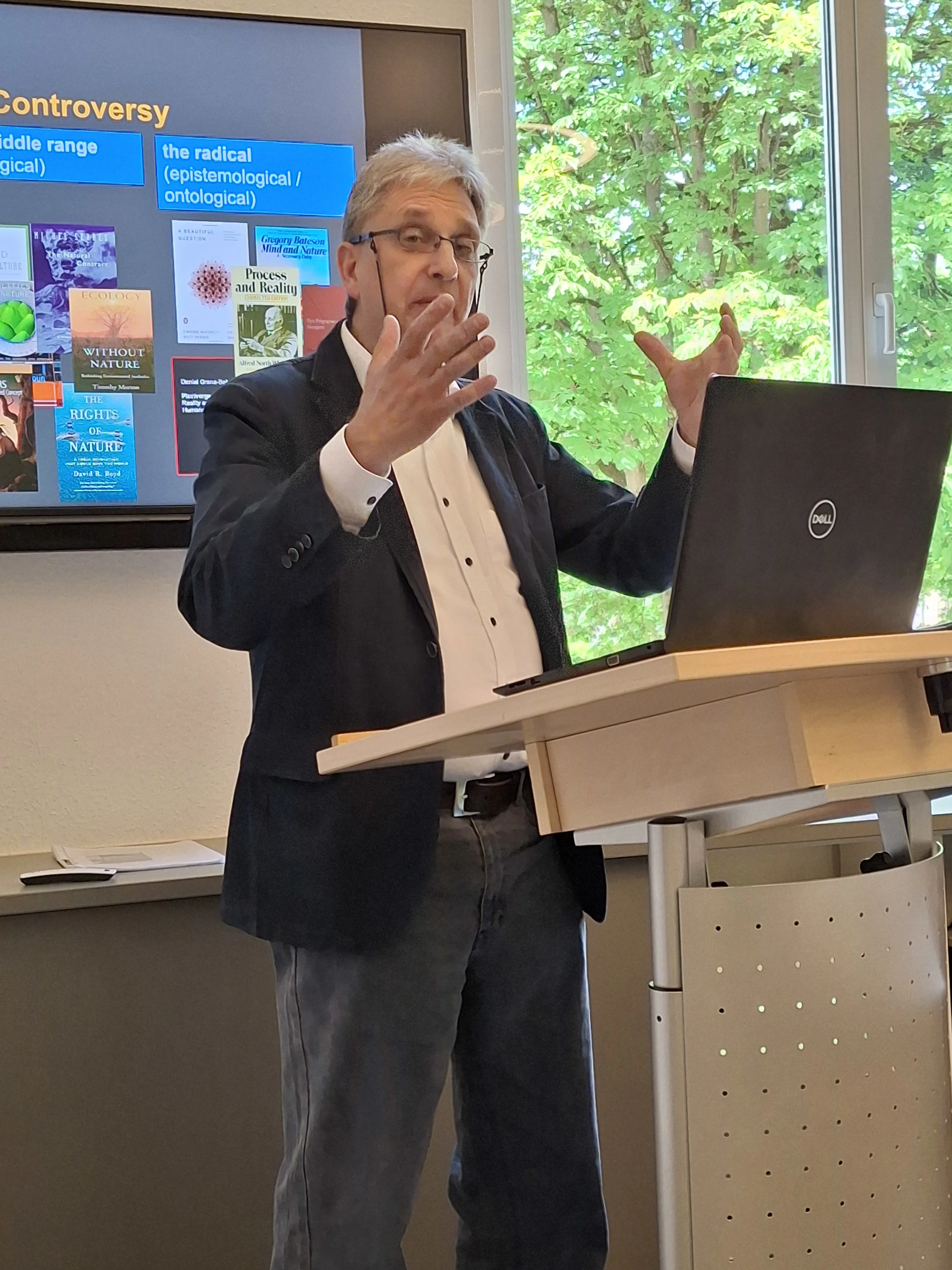
Subsequently, Pierre Brunet addressed the challenges surrounding the legal construction and implementation of "Rights of Nature" in his talk, "The Rights of Nature: Between Law and Environmental Ethics." Here, too, we are dealing with a categorical upheaval. His presentation demonstrated that the rights of nature, raising the question - "Do rocks have rights?" - have become an increasingly important yet controversial legal innovation beyond the scope of traditional environmental law, as they signal a profound shift in how we perceive the relationships between humans and non-humans. Actors in this field aim to transform the concept of nature so that it is no longer viewed merely as a resource, object, asset, or commodity—something to be appropriated and possessing no value other than the instrumental value assigned to it by the market economy. By tracing legal-doctrinal debates across various eco-legal cultures since the 1960s and discussing examples such as Ecuador, Bolivia, New Zealand, Colombia, and Spain, he highlighted both the growing normative influence of ecocentric arguments on the judiciary and the limitations faced during their implementation by policymakers and administrative bodies. This trend sees courts and advisory panels attempting to set boundaries for political action, even at the risk of creating tensions regarding the separation of powers. Ultimately, he observes the rising prevalence of an ecocentric interpretation of the law—one grounded in the recognition of the interdependence between humans and non-humans and which derives legal claims from this relationship.
Against this backdrop of diverse discourse regarding the human-nature relationship, Ines Dombrowsky turned her attention to the societal and political decisions required—decisions modeled within long-term transformation scenarios aimed at achieving the SDGs and the 1.5°C target. Her analysis, titled "Sustainable Development Scenarios: Reflections on Societal and Policy Assumptions," focused particularly on governance models, policy instruments, and coherent policy mixes. She demonstrated that while such scenarios rely heavily on economic and regulatory instruments and can enhance policy coherence compared to earlier climate scenarios, they also rest on demanding underlying assumptions—such as effective governance, the rule of law, institutional capacity, and, fundamentally, peace. These assumptions cast significant doubt on the feasibility of implementation under current geopolitical conditions, yet the scenarios nonetheless offer practical pathways out of the crisis.
 © Privat
 © Privat
 © Privat
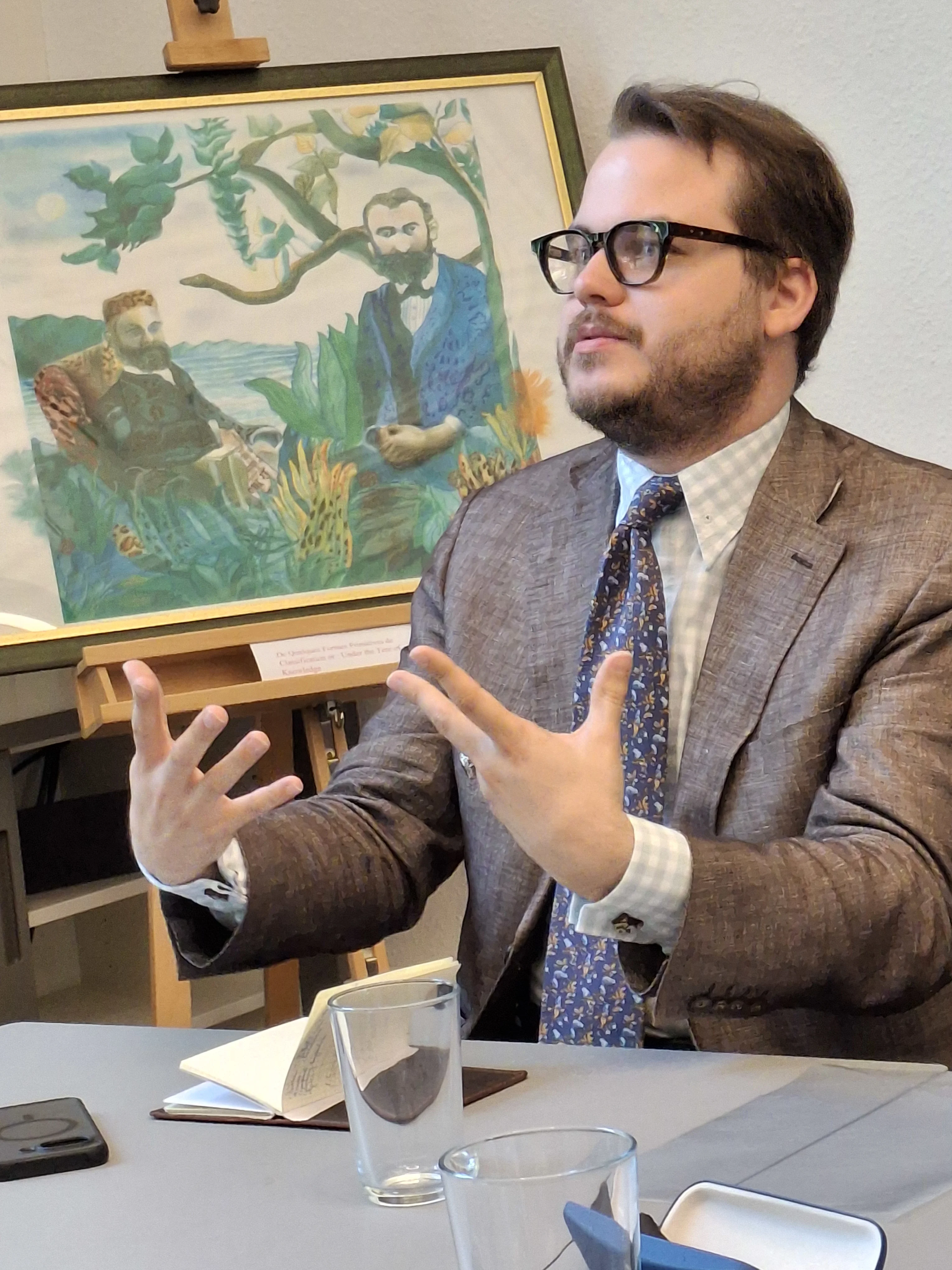
Daniel Grana-Behrens’s presentation deepened the day’s conceptual dimension by asking what “nature” still signifies amidst current crisis conditions: “What Nature? The Epistemological Crisis as an Ontological Crisis – From Anthropology to Sociology.” He argued that the epistemological crisis surrounding the question of nature (What do we know?) has evolved into an ontological crisis (What is it?), with neither taking precedence over the other. He thus proposed that “nature” should no longer be treated as a stable, unproblematically usable concept, but rather as a term requiring re-examination, even, or especially, under crisis conditions. Drawing on anthropology, the ontological turn, and posthumanist and ecological debates, he examined positions ranging from the idea of “no nature” to pluralistic and process-oriented understandings. In doing so, he moved the conference discussion beyond environmental concerns toward a more fundamental rethinking of how various crises emerge and the role humans play within them. His concluding thoughts could be summarized as a threefold perspective on crises of “nature”: the ecological crisis, calling for Anthropocene thinking and the serious consideration of the indigenous concept of “non-nature”; the crisis of nature, calling for ecological thinking and attention to the concerns of non-humans in order to find a new universalism beyond nature; and the ontological crisis, calling for posthuman thinking and the development of a new universalism that encompasses all forms of nature, in order to understand how different worlds emerge together.
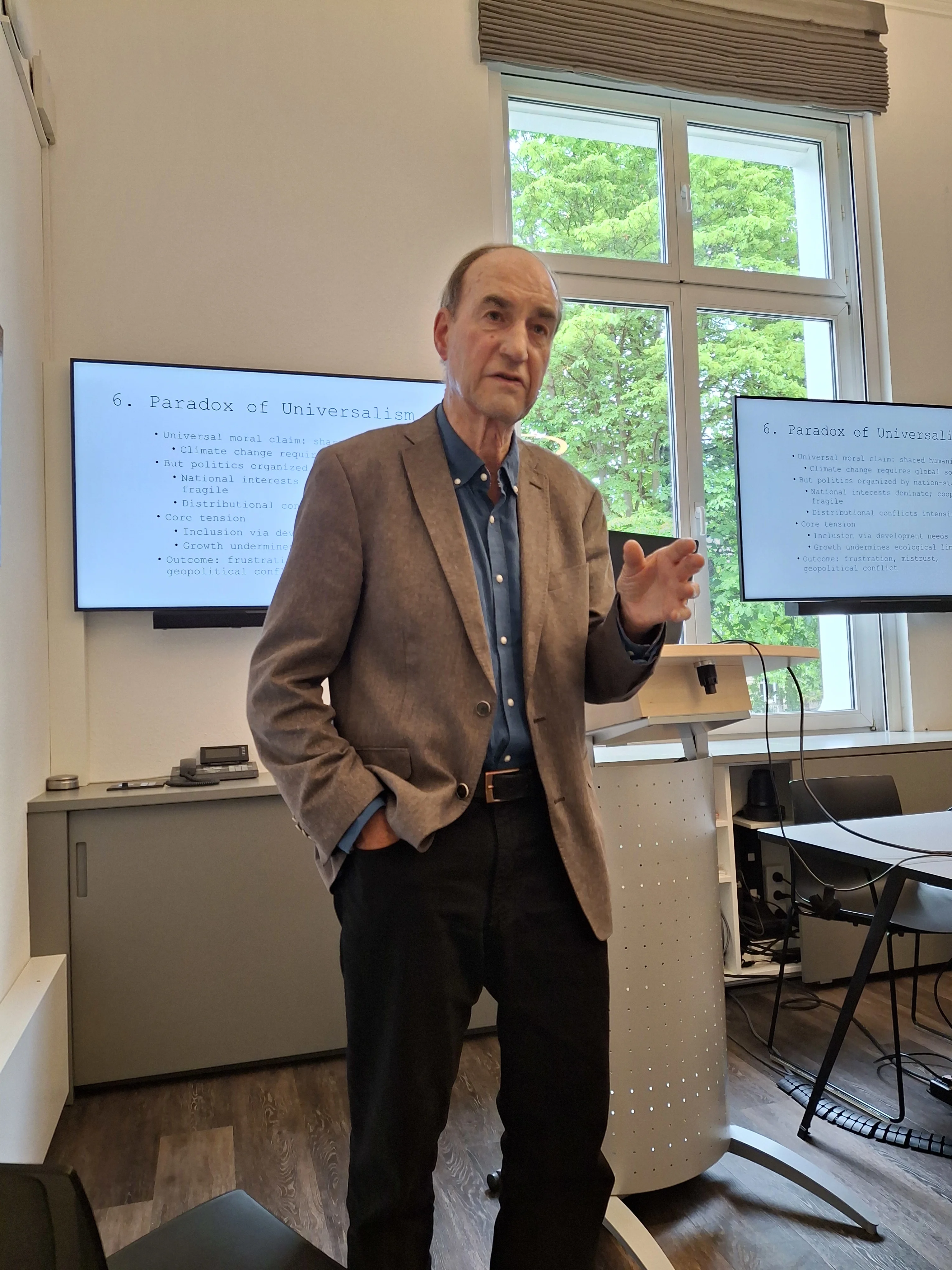
Finally, Richard Münch outlined the sociological horizon of climate change as a structural test for modernity, proposing a perspective based on paradoxes, rather than contradictions, for analysis: “Climate Change: The Culture of Modernity in Reflexive Self-Confrontation.” He argued that climate change should be viewed not as an external disturbance but as an internal consequence of the normative principles of modern society itself—and addressed from within that very framework. By centering his analysis on the paradoxes of rationalism, individualism, universalism, and interventionism, which constitute the "culture of modernity", he demonstrated why, despite our knowledge of the causes of climate change, there are no commensurate attempts to resolve the climate crisis; instead, modernity continually gives rise to new paradoxical structures.
In short: increased knowledge generates greater uncertainty; individual responsibility obscures structural dependencies; demands for global solidarity clash with national interests; and every intervention produces new side effects that necessitate further interventions. Climate change thus emerges as a permanent problem of modernity—one that can only be addressed through a reflexive approach to uncertainty, responsibility, and political governance, without succumbing to paralysis. Political decisions should therefore be understood—in the spirit of Popper—as "hypotheses" that remain open to verification and revision at any time. Democracy, as a form of government, represents the best means for "Western modernity" to respond to climate change precisely because—crucially—it can correct errors while simultaneously generating legitimacy, thereby balancing the paradox of necessary "rapid action" with the capacity for correction.
Conclusion
Overall, it became clear that the climate crisis extends far beyond mere ecological issues. It manifests simultaneously as a crisis of concepts of nature, cultural interpretation, legal frameworks, and political agency. While the contributions shed light on the symbolic, theological, and epistemological dimensions of the human-nature relationship, they also focused on the institutional, legal, and governance-related consequences of this crisis. A recurring theme across the various presentations was the recognition that "nature" can no longer be viewed as a passive backdrop to human history; instead, it has become a contested arena where aesthetic perception, normative claims, assumptions about governance, ontological uncertainty, and social paradoxes intersect.
Ultimately, the conclusion was not the prospect of a simple solution, but rather an insight into the need for an approach to a world in flux that is reflective, capable of learning, and normatively sensitive. The conference powerfully demonstrated that addressing climate change inevitably entails grappling with the very foundations of our own thinking, judgment, and action.
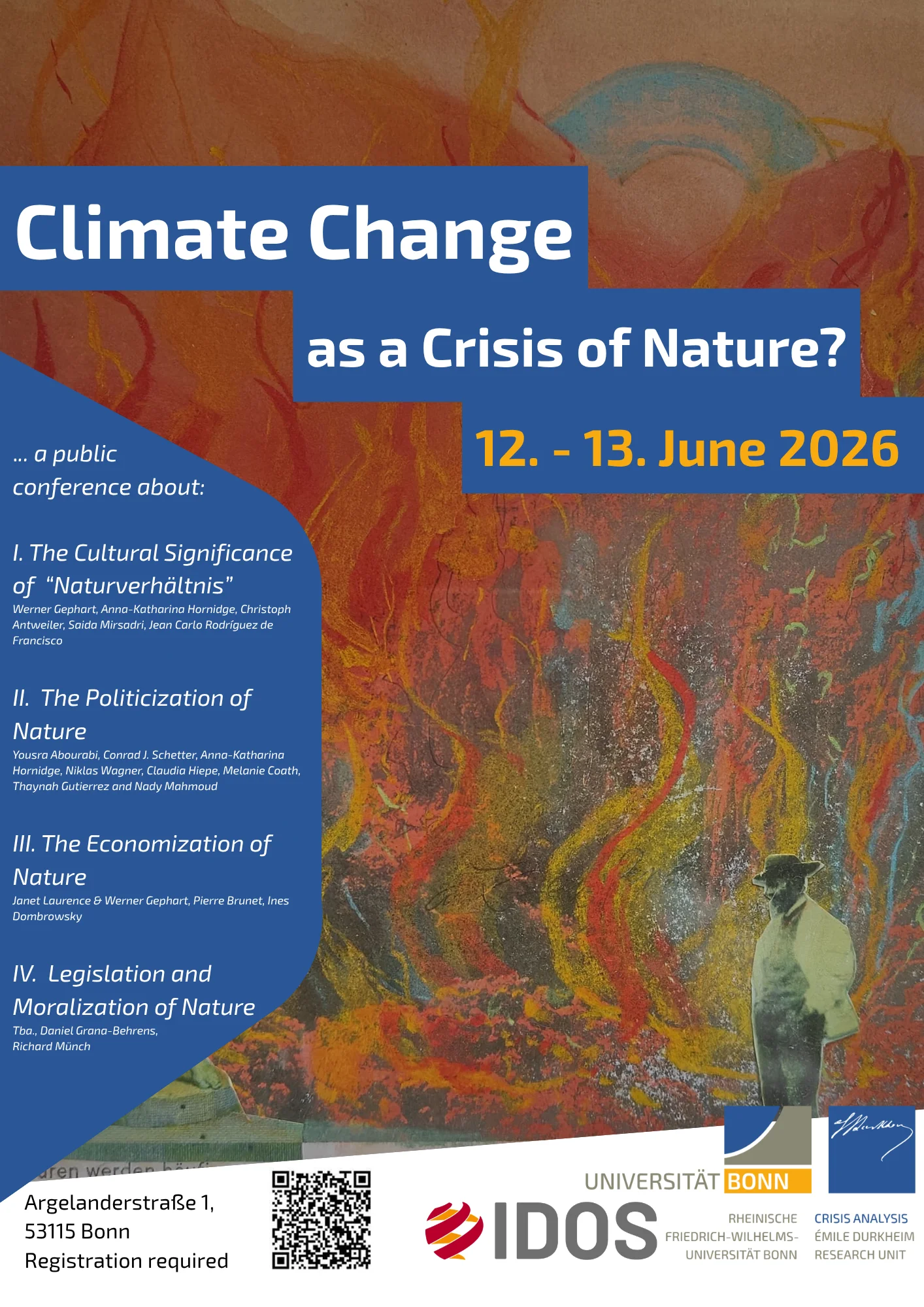
Programm & Speakers