Eighty years after the end of the Second World War, there is an urgent need to remember the horrors of war once again. In the immediate present, it is deeply disturbing to see Russia's war of aggression against Ukraine still in full swing. Witnessing a devastating act of terror and the almost complete destruction of Gaza is a harrowing confrontation with the present. Must we now counter the illusion of a peaceful world, in which war took place mainly outside the so-called West, with a new realism? Should we intensify our research into war, which confronts us, at least on a cognitive level, with the return of terror?
The Émile Durkheim Research Centre, which is dedicated to the analysis of crises, is focusing this year on the history, present and structures of war. It aims to address not only the new modalities of war (cyberwars, drone warfare, defence systems, biological weapons, etc.) – i.e. the technology of war – but also to include the “culture of war”. Symbolic representations in images and films, in literary texts, war diaries, letters and even email communication from the “field” are of particular importance for the cultural studies approach to the phenomenon of war.
What is striking here are similar processes of social transformation, when both the functional differentiation of the spheres of politics, economy, culture and community merge and the stratum- and class-related vertical differentiation seems to dissolve in a sense of unity in the experience of war – for a certain moment of war enthusiasm. How war profiteers and war invalids are integrated into post-war society or remain marginalised as traumatised individuals provides material for literature and visualisations in images and film formats. At the same time, in the process of civilisation, as Norbert Elias called it, we observe how bellicose sentiments are also integrated into normative orders, such as jus ad bellum and jus in bello. But here, too, new weightings are taking place in relation to international humanitarian law, changing the “face of war” (Ernst Jünger).
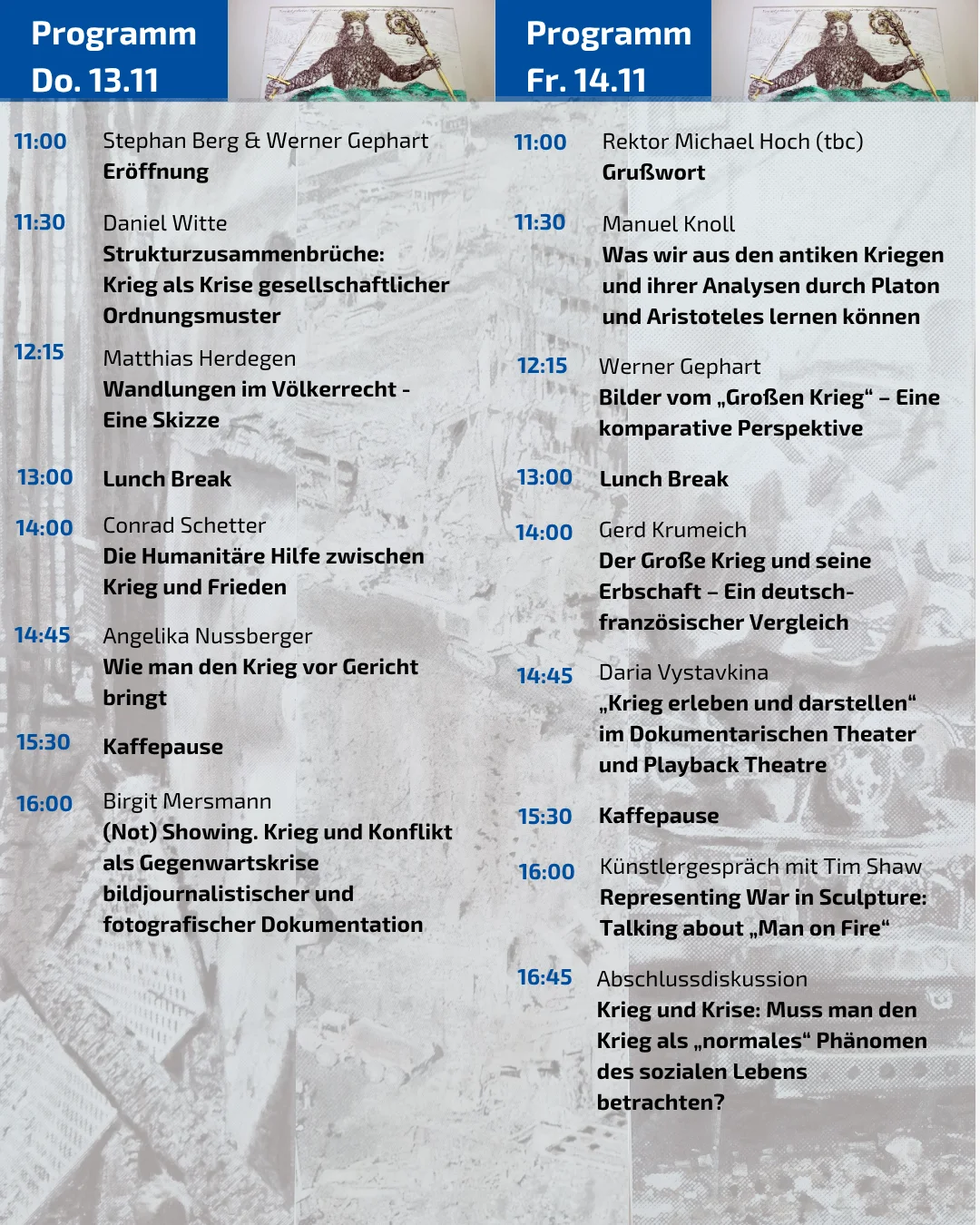
On the first day, we will look at the legal, sociological and art-historical dynamics of war, as well as its cultural expressions and perceptions.
The second day will focus on (art) historical processes and artistic forms of expression that accompany wars or emerge from them, and will examine the normative foundations and anomic conditions that they unleash.
The aim of the conference is to understand war not only as a political or military event, but also as a profoundly social and cultural one.
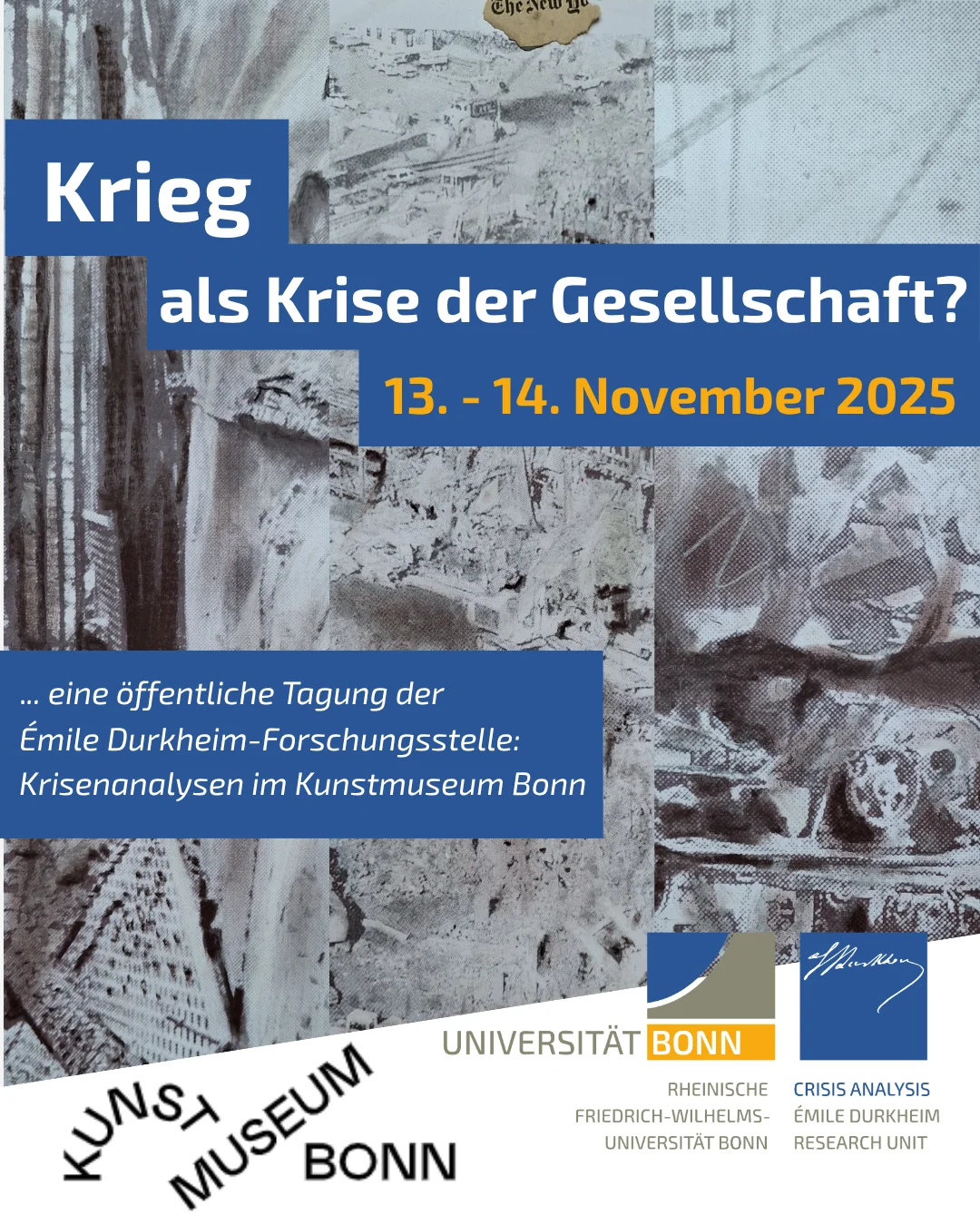
The conference will take place at the Kunstmuseum Bonn (Helmut-Kohl-Allee 2).